Research
Economic impact
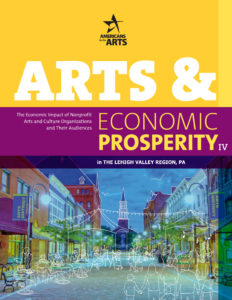 Once every five years, the Lehigh Valley Arts Council partners with to conduct , an economic impact study of the nonprofit arts and culture industry in the Lehigh Valley. The results of this research clearly demonstrates that the arts mean big business in the region.
Currently, the Lehigh Valley Arts Council is gathering data for the study. If you are a nonprofit cultural organization in Carbon, Lehigh and Northampton counties and have not been contacted to participate, please to learn how to be represented in the study.
View the summary of Arts & Economic Prosperity IV
Read the final report of Arts & Economic Prosperity IV
Lehigh Valley Arts = Business & Jobs
- The 2012 economic impact study of the region’s nonprofit arts industry revealed a $208 million industry—one that provides 7,114 full-time jobs and generates $21 million in state and local taxes annually.
- The creative industries number 1,405 nonprofit and for-profit businesses and employ 7,714 employees – comprising 3.8% of all businesses and 2.3% of all employees in the region.
| Date of Report | 2003 | 2007 | 2012 |
|---|---|---|---|
| ATTENDANCE: RESIDENTS / NONRESIDENTS | 2.25M / 1.2M | 2.6M / 1.1M | 3.35M / 1.68M |
| STUDY | Arts & Economic Prosperity II | Arts & Economic Prosperity III | Arts & Economic Prosperity IV |
| # OF PARTICIPANTS | 76 | 88 | 91 |
| TOTAL EXPENDITURES | $113M | $169M | $208M |
| FULL-TIME JOBS | 3,652 | 6,216 | 7,114 |
| LOCAL GOV’T REVENUE | $2.7M | $6.8M | $8.2M |
| STATE GOV’T REVENUE | $7.6M | $11.1M | $13.1M |
Whose Business is the Arts?
The fourth Whose Business is the Arts? public forum took place on June 7, 2012, to release the results of the Arts & Economic Prosperity IV and examine its relevance to the local economy.

The goal of the event was to stimulate a dialogue to promote sustainability and entrepreneurship in the nonprofit arts sector, bringing together business executives, corporate contributors, artists, arts administrators, foundation representatives, board members, and government officials.
In January 2016, the Lehigh Valley Arts Council will once again embark on this eighteen month research study and continue to chart the region’s growth. The subsequent public forum, Whose Business is the Arts?, will be held in Spring 2017 to release the results and compare them to national trends.
Arts in Education
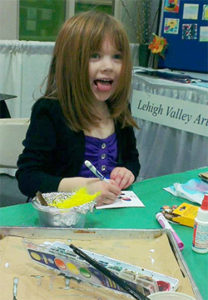 The Lehigh Valley Arts Council worked to administer the State of Arts-in-Education K-12 Study in the public and private schools in the twenty-two districts in our three-county region during this past 2014-15 academic year. Data collection ended on June 12, 2015, and we are currently working to compile the results.
The 2008 study “Snapshot of the State of Arts-in-Education in K-12” provided a base line from which to determine the impact of the recent economic downturn on the amount of arts practices and the number of arts specialists in our schools. Once the analysis and report are completed in the summer 2015, the Arts Council plans to co-host a public forum in Fall 2015 and release the results.
Goals of the Arts-in-Education Study:
- to unite the educational community around the value and role of arts education;
- to develop a network of arts-in-education practitioners and advocates that can learn from each other’s successes in overcoming obstacles and making a positive impact on learning; and
- to engage all 22 districts’ faculty and principals.
All answers are confidential. The data that was collected will be analyzed in the aggregate, and no individual school or school district will be cited in the reporting. In order to ensure privacy, the records of the study will be kept in a locked file; only the researchers will have access to the records.
Cultural Accessibility
According to U.S. Census data estimates from 2012, the number of non-institutionalized people with disabilities living in the Lehigh Valley is 81,000, or 12.7%, which represents a significant number of potential new audiences for the cultural community.
Since 2013, the Lehigh Valley Arts Council has been collaborating with the to present Arts & Access, a yearlong celebration commemorating the 25th Anniversary of the through the lens of the arts.
 In preparation for the celebration, the Arts Council and the Partnership conducted an audit of current accessibility practices in the region in 2014. The results showed a significant need to provide training to cultural organizations and build more awareness of the challenges and barriers that exist for people with disabilities to participate in cultural events.
The surveys indicate that less than 13% of the cultural groups offer open captioning, sign language interpreters, audio description, and Braille printed materials. Only 16.7% offer large print brochures; and 29% offer assistive listening devices.
Arts & Access evolved from the work in the field and the relationships that both the Arts Council and the Partnership have nurtured to create a more inclusive region. The existing infrastructure, the power of the arts to bring people together, and the upcoming —all of these factors support the timing of this endeavor.
GOALS of Arts & Access:
- Expand cultural access to all people with disabilities;
- Help cultural Nonprofits build audiences for their events; and
- Promote the benefits of inclusion by telling the stories of how engagement in the arts is transformative.